Xor with one neuron
Experiment: XOR with one decision neuron
Experiment date: July 31, 2026
Distribution: Sensory 0.1.0 for Windows
Network: XorOneNeuron
Objective
The objective was to create a Cognia example that uses one trained decision
neuron, can be trained with cognia_train.exe, served by cognia_serve.exe, and
called from a PHP CLI client over REST to evaluate XOR inputs.
Mathematical limitation
A conventional neuron over two raw inputs computes a function similar to:
y = tanh(wA*A + wB*B + bias)
Its decision boundary is linear. XOR is not linearly separable: (0,0) and
(1,1) belong to class 0, while (0,1) and (1,0) belong to class 1. No single
line separates these sets.
The experiment therefore retains one trained decision neuron but changes the input representation. PHP converts the two bits into a one-hot truth-table state:
| A | B | Cognia input [00,01,10,11] |
Target |
|---|---|---|---|
| 0 | 0 | [1,0,0,0] |
0 |
| 0 | 1 | [0,1,0,0] |
1 |
| 1 | 0 | [0,0,1,0] |
1 |
| 1 | 1 | [0,0,0,1] |
0 |
The nonlinear decomposition happens before the neuron. The neuron learns four
independent truth-table weights. This is feature engineering, not evidence that
one neuron can solve XOR directly over [A,B].
Files and topology
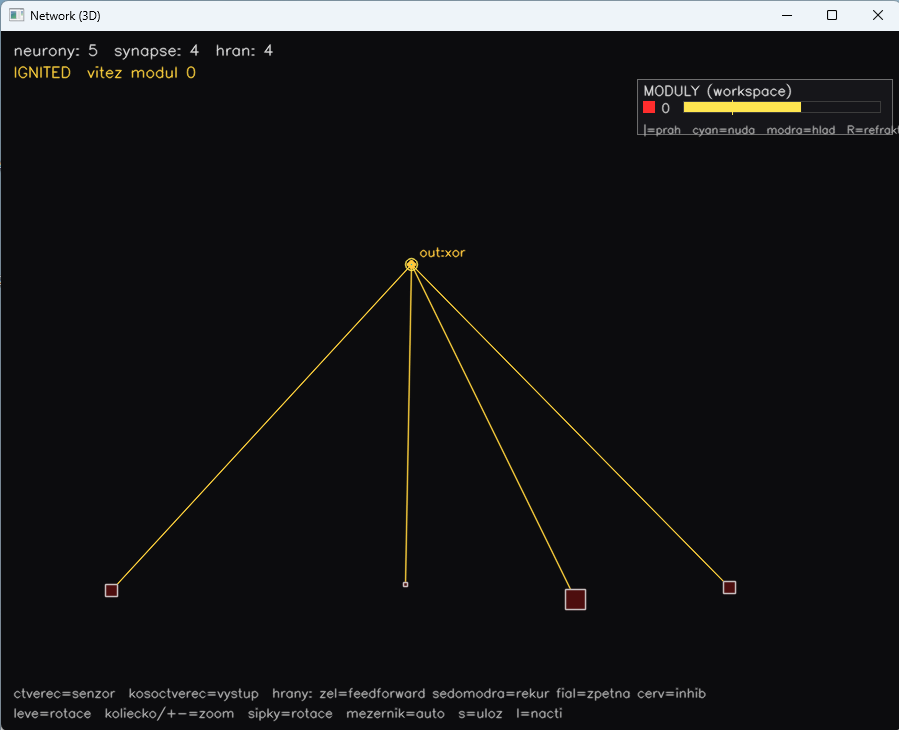
xor-one-neuron.cognia— four sensors and one decision neuron;xor.dataset— the complete four-row truth table;client.php— CLI client and(A,B)to one-hot conversion;README-cz.md/README-en.md— usage instructions;networks/xor-one-neuron.bin— trained weights.
The runtime topology has five neuron instances: four input sensors and one trained output neuron, connected by four synapses.
Training
.\bin\cognia_train.exe `
  .\Cognia\examples\xor-one-neuron\xor-one-neuron.cognia `
  .\Cognia\examples\xor-one-neuron\xor.dataset `
  2000 XorOneNeuron `
  --save .\networks\xor-one-neuron.bin
The model has one numeric output, so --softmax is not used. Mean squared error
was approximately 0.5616 before training and 0.0754 after 2,000 iterations.
| Input | Target | Activation after training |
|---|---|---|
[1,0,0,0] |
0 | 0.325 |
[0,1,0,0] |
1 | 0.751 |
[0,0,1,0] |
1 | 0.751 |
[0,0,0,1] |
0 | 0.269 |
The client uses a decision threshold of 0.5.
REST verification
The server was bound to the loopback interface:
.\bin\cognia_serve.exe `
  .\Cognia\examples\xor-one-neuron\xor-one-neuron.cognia `
  .\networks\xor-one-neuron.bin `
  --network XorOneNeuron --host 127.0.0.1 --port 8080
The PHP client calls POST /evaluate, for example:
{"input":[0,1,0,0],"iters":12}
End-to-end results from the saved network, real REST server, and PHP client:
| A | B | REST activation | Result |
|---|---|---|---|
| 0 | 0 | 0.268506 | 0 — OK |
| 0 | 1 | 0.685969 | 1 — OK |
| 1 | 0 | 0.686511 | 1 — OK |
| 1 | 1 | 0.220954 | 0 — OK |
Values during a separate server run differ slightly from the trainer report, but
all retain an adequate margin around the 0.5 threshold. The client reads raw
output[0]; it does not use outputs[0].active, because the signal actuator
derives its level from absolute activation and is unsuitable for general scalar
classification.
Unsuccessful variants and findings
Direct gated readout edges
The first design used four gated A_i × B_j edges directly into the decision
neuron. The topology was valid, but the single-channel delta trainer did not
reliably distinguish the gated features. After 2,000 iterations, all outputs
collapsed near 0.69.
This suggests that the single-channel supervised update does not account for the
gate in exactly the same way as the forward pass, or updates with pre rather
than pre × gate. The runtime source should be inspected to confirm this.
Fixed conjunction hidden layer
The second design materialized four conjunctions as helper neurons and trained only their edges into the output. It was also unstable: longer training increased the error, and one positive case did not learn consistently.
This supports the known limitation that the runtime has no general deep credit assignment. Fixed state or product modules can form a substrate, but the trainer needs an unambiguous definition of readout features and trainable edges.
Conclusion
The final variant is a small, reproducible demonstration of training,
serialization, and REST inference with one decision neuron. It solves XOR by
explicitly encoding the truth table in the client. Native XOR over raw [A,B]
requires reliably trainable product features, a nonlinear hidden layer, or deep
learning support in Cognia.